
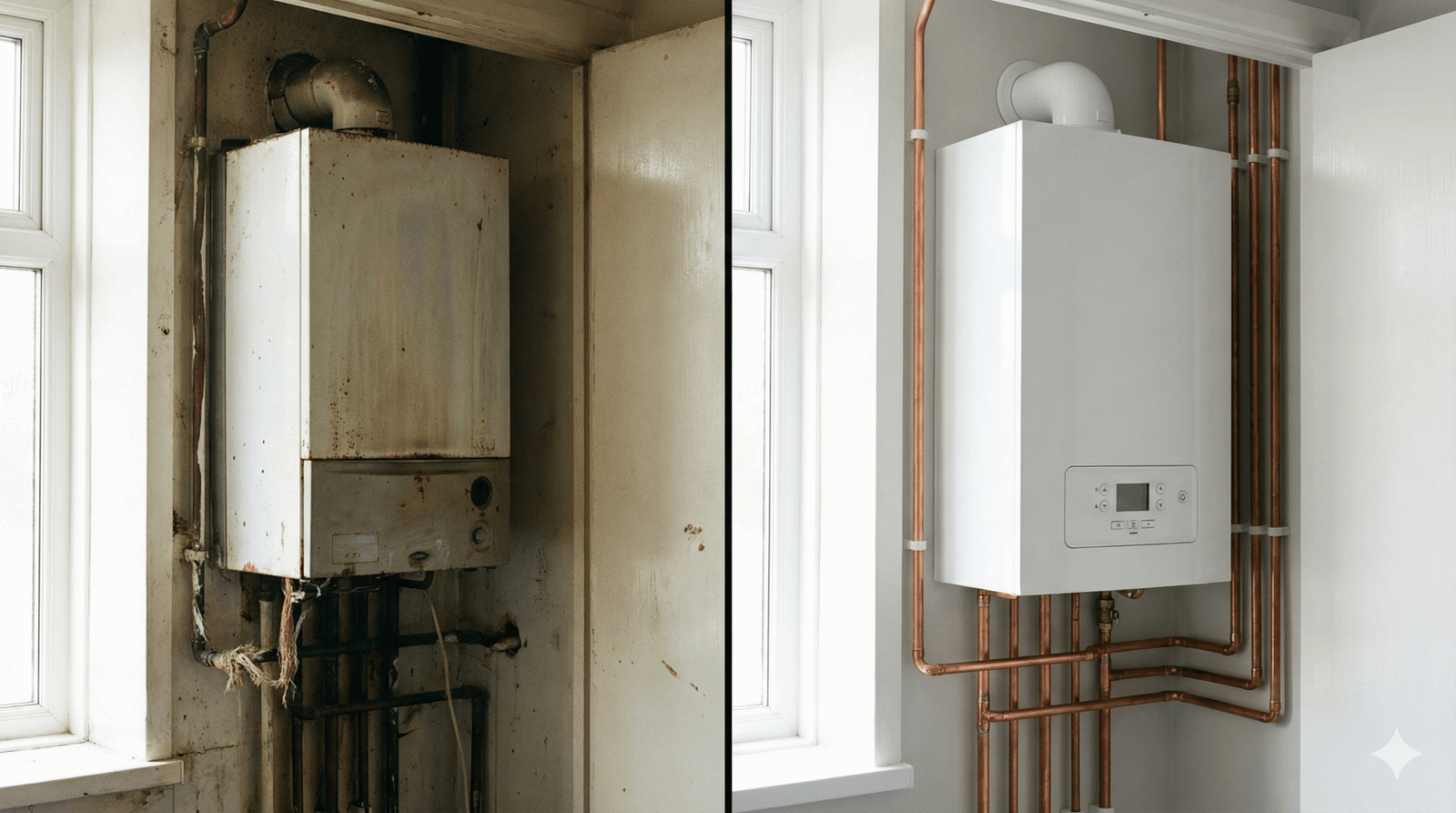
New Boiler vs Boiler Repair – How Homeowners Should Decide
It usually happens on the coldest Tuesday of the year. You wake up, turn on the shower, and… nothing. Just a blast of freezing water that wakes you up faster than any espresso.
As the team behind Anglian Plumbing Heating and Electrics, we see this scenario every winter. The panic sets in immediately. You are standing there, shivering, wondering if this is a simple £150 fix or a £2,500 catastrophe.

The debate of new boiler vs boiler repair is one of the most expensive decisions a homeowner has to make. Make the wrong choice, and you could be throwing good money after bad on a dying machine. But replace it too early, and you’ve spent thousands you didn’t need to.
In this guide, we are going to walk you through the exact decision matrix we use when advising our own customers. No sales fluff—just the cold, hard maths of heating.
The “50% Rule” and The Age Factor
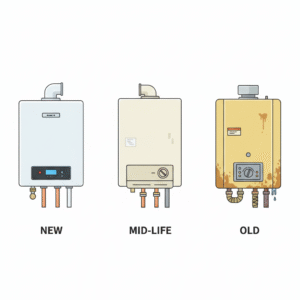
When we arrive at a call-out, the first thing we look at isn’t the broken part—it’s the boiler’s birth date.
Boilers in the UK are workhorses. They run for about 2,500 hours a year. If you drove your car for that long at 40mph, you’d rack up 100,000 miles every single year. It’s no wonder they eventually give up.
1. The Age Threshold
Under 7 Years Old: Almost always repair. Unless the unit has been catastrophically neglected, a boiler this young has plenty of life left.
7–12 Years Old: The “Danger Zone.” This is where the decision gets tricky. You need to weigh the cost of the repair against the boiler’s remaining lifespan.
Over 12 Years Old: You are on borrowed time. Even if we fix the current issue, another component is likely to fail within 12 months.
2. The 50% Rule
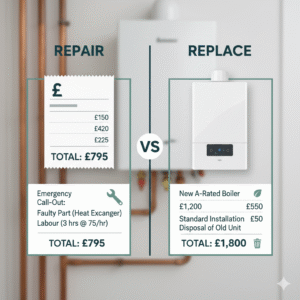
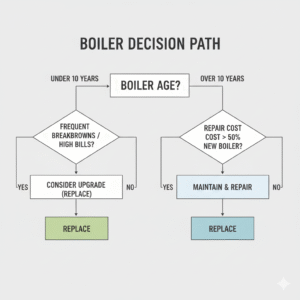
We often advise customers to use this simple formula: If the cost of the repair is more than 50% of the cost of a new boiler (or the current value of your boiler), replace it.
For example, if you need a new heat exchanger and fan on a 10-year-old boiler, the quote might hit £600–£800. A brand new, A-rated combi boiler might cost you around £2,000–£2,500 installed. Spending nearly 40% of the cost of a new unit on a decade-old machine rarely makes financial sense.
The Hidden Costs of “Just Patching It Up”
Many homeowners look at the upfront cost: £300 for a repair vs £2,500 for a replacement. The repair looks cheaper. But that’s ignoring the efficiency tax you pay every month.
The Efficiency Gap (G-Rated vs A-Rated)
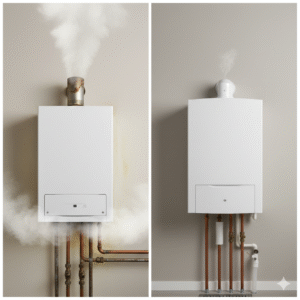
Older boilers (specifically non-condensing ones installed before 2005) are often G-rated. This means they run at about 60-70% efficiency. For every £1 you spend on gas, 30p-40p is literally going straight up the flue.
Modern condensing boilers, mandated by UK building regulations, must be at least 92% efficient (A-rated).
The Maths: According to 2025 data from the Energy Saving Trust, upgrading a G-rated boiler to a new A-rated condensing boiler can save a semi-detached household roughly £300–£400 per year on energy bills.
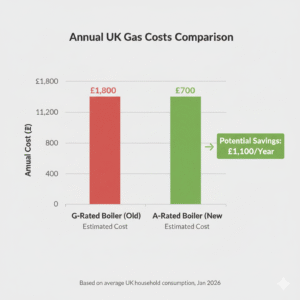
Repair Path: You pay £300 for the repair + continue paying high bills.
Replace Path: You pay for the boiler, but the savings effectively “pay back” the installation cost over 5-7 years.
When You Should Definitely REPAIR
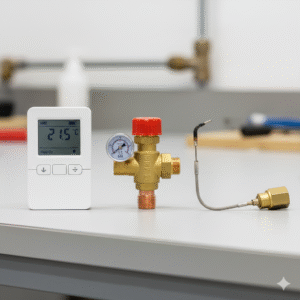
We don’t want to sell you a new boiler if a £50 part will sort you out. Here is when a repair is the smart move:
1. It’s a Peripheral Component
If the issue is a faulty thermostat, a pressure relief valve, or a thermocouple, these are relatively standard, affordable repairs. They don’t indicate that the “heart” of the boiler is failing.
2. Parts are Readily Available
If your boiler is a popular model (like a Worcester Bosch Greenstar or a Vaillant Ecotec) and under 10 years old, parts are easy to source. If your engineer has to scour eBay for a refurbished fan because the manufacturer stopped making them in 2014, take that as a sign to upgrade.
3. You Plan to Move Soon
If you are selling your house in the next 6 months, you won’t recoup the investment of a new boiler through energy savings. However, be aware that a very old boiler can come up on a surveyor’s report and might force you to lower your asking price.
When You Should Definitely REPLACE
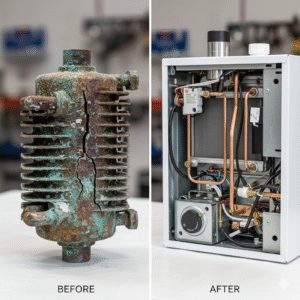
There are certain failures where we almost always recommend cutting your losses.
1. The Heat Exchanger Has Failed
This is the engine of your boiler. If it cracks or scales up badly, the replacement cost is astronomical—often £500+. It’s the equivalent of a blown engine in a car. Scrapping it is usually the better option.
2. The PCB (Printed Circuit Board) Has Gone
The “brain” of the boiler. On older models, replacing a PCB can be surprisingly expensive and tricky. If the brain goes on an old boiler, the body usually isn’t far behind.
3. Your Radiators are Cold at the Bottom (Sludge)
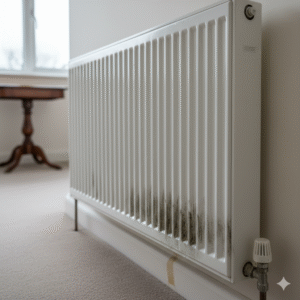
This isn’t just a repair; it’s a system issue. If your old boiler is clogged with magnetite (black sludge), simply fixing the broken part won’t help. You likely need a Powerflush and a new boiler with a magnetic system filter (like a MagnaClean) to prevent it from happening again.
Future-Proofing: What About Hydrogen?
A common question we get in 2025: “Should I wait for hydrogen boilers?”
The short answer: No. The government and industry have moved toward “Hydrogen-Ready” boilers. Most modern gas boilers installed today are designed to accept a 20% hydrogen blend without any modification. If the gas grid changes in the future, your new boiler will likely cope just fine or require a very minor part swap. Waiting for a “pure hydrogen” boiler that doesn’t exist yet will just leave you cold today.
Conclusion: The Peace of Mind Factor
Finances aside, there is a value to peace of mind.
An old boiler is like an old car—you never quite trust it to get you to your destination. If you have young children or elderly relatives in the home, the risk of a breakdown in January is a stress factor worth eliminating.
New boilers usually come with warranties ranging from 5 to 12 years (depending on the manufacturer and installer). That is up to a decade of not worrying about repair bills.
Our Final Verdict:
Repair if: The boiler is under 7 years old and the repair cost is under £300.
Replace if: The boiler is over 12 years old, or the repair costs more than half of a new unit.
Still not sure? Don’t guess with your gas. At Anglian Plumbing Heating and Electrics, we can provide a transparent assessment of your current system. We’ll give you the honest numbers—repair vs replacement—and let you decide.
[Contact Anglian Plumbing Today for a Boiler Assessment]
Frequently Asked Questions (FAQ)
How much does a new boiler cost in the UK in 2025?
The average cost for a straightforward combi boiler swap is between £2,000 and £3,000, including installation and VAT. If you are converting from an old tank-fed system to a combi, expect to pay between £3,000 and £4,500 due to the extra pipework involved.
Are there grants available for new boilers?
Yes, but they are targeted. The ECO4 scheme provides free boiler upgrades for low-income households or those receiving certain benefits. For heat pumps, the Boiler Upgrade Scheme (BUS) offers £7,500 vouchers, though this requires switching away from gas entirely.
How long does it take to install a new boiler?
A straight swap (combi to combi) usually takes 1 day. Converting a system boiler (with a hot water tank) to a combi boiler typically takes 2 days.
Is it worth repairing a 15-year-old boiler?
Almost never. At 15 years old, a boiler is significantly less efficient (likely G-rated) and prone to multiple component failures. Money spent repairing it is usually better put toward a deposit on a new, efficient model.
Can I install a boiler myself?
Absolutely not. In the UK, it is a legal requirement that any work on gas appliances be carried out by a Gas Safe Registered engineer. Attempting it yourself is illegal, dangerous, and will void your home insurance.
Visual Content Suggestions (For Publication)
Infographic: A “Repair vs Replace” Flowchart. Start with “How old is your boiler?” and branch off into “Under 7 Years”, “7-12 Years”, “12+ Years” with Yes/No paths for repair costs.
Chart: “The Cost of Inefficiency” – A bar chart showing annual gas bills for a G-rated boiler (£X) vs an A-rated boiler (£Y) to visualize the £300+ savings.
Image: A photo of a corroded heat exchanger (to show readers what a “major failure” looks like) next to a shiny new internal unit.
Screenshot: A snapshot of a standard Energy Performance Certificate (EPC) showing where the boiler rating sits.
Author Bio
Anglian Plumbing Heating and Electrics is a trusted provider of heating solutions in East Anglia. With a team of fully qualified Gas Safe engineers, we specialize in boiler diagnostics, repairs, and energy-efficient installations. We are committed to keeping UK homes warm, safe, and efficient.